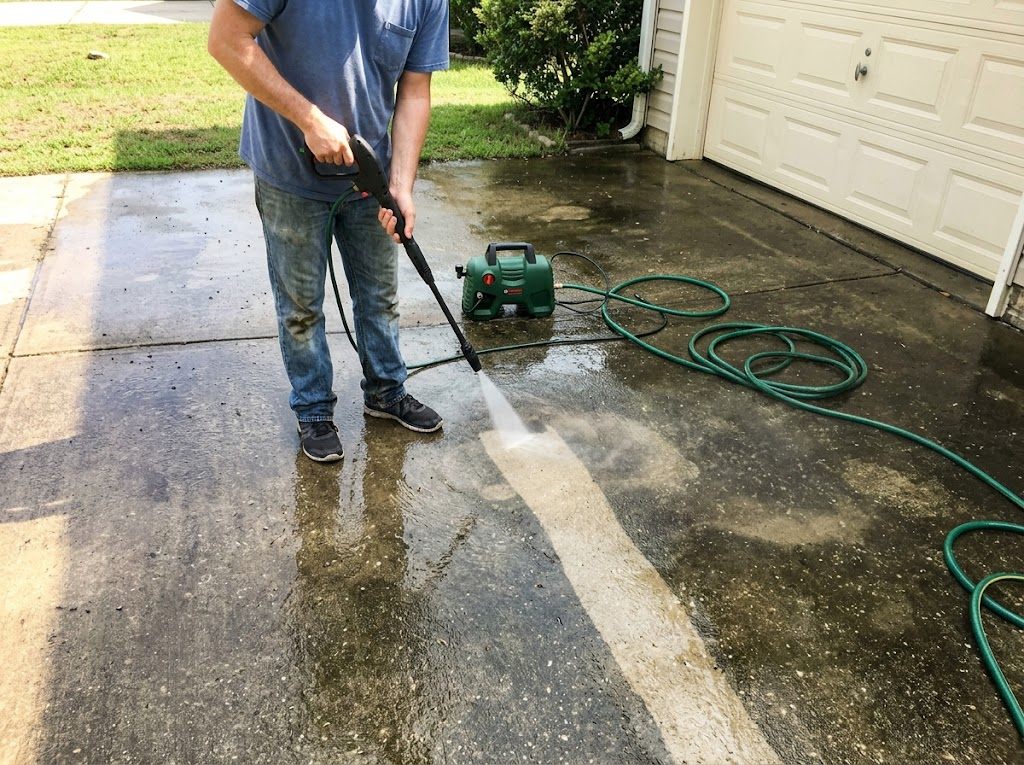
Three seasons ago we bought our first pressure washer to clean a moss-streaked back patio. We chose it the way most people choose a pressure washer: by reading the PSI number on the box and picking the biggest one in our budget. That decision turned out to be the second-most-important specification on the box, and not by a lot. This guide is what we wish someone had handed us.
We've since rented or bought four pressure washers across two homes — a budget electric, a mid-range electric, a small gas unit we borrowed from a neighbor for a weekend, and a battery-powered one for comparison. Below is what actually matters when you're shopping for one, in roughly the order it should change your decision.
1. Pressure (PSI) is overrated
Pressure washers are sold on PSI: 1,800 PSI, 2,300 PSI, 3,000 PSI. Bigger numbers, bigger boxes, more shelf presence. For homeowner use cleaning patios, fences, siding, and cars, almost any electric model in the 1,800–2,300 PSI range will do the job. The difference between 1,900 PSI and 2,400 PSI is real but not dramatic — you'll feel it on caked-on concrete grime and not much else.
What changes a lot more than PSI is flow rate: gallons per minute (GPM). A washer with higher GPM rinses faster even at lower PSI, which means you spend less time on each surface. You'll see a single combined "cleaning units" number sometimes (PSI × GPM); it's a clearer metric than PSI alone. We'd choose a 1.6-GPM, 2,000-PSI washer over a 1.2-GPM, 2,600-PSI one almost every time.
2. Electric vs gas vs battery
Electric (corded)
The default for most homeowners. Quieter, lighter, no fuel, starts instantly. The downside is the extension cord and the limited reach. If you have an outlet on the side of the house and a small to medium yard, this is the right answer.
Gas
More flow, more pressure, no cord. The cost is real: noise, fuel, oil changes, off-season storage that involves draining or stabilizing fuel, and a unit that probably weighs over 50 lbs. Worth it if you have a long driveway, a multi-car detailing setup, or a half-acre of fence to do every spring. Overkill for a small townhouse patio.
Battery
The newcomer. We tested one for a weekend; the convenience is real but the runtime is short. For quick rinses (car, lawn furniture, deck stairs) it's lovely. For a full patio job, you'll be swapping batteries and waiting on chargers. Not yet a primary choice for homeowners doing serious cleaning.
3. The things on the box you should actually check
Hose length
Two of the units we tested came with 20-foot high-pressure hoses. One came with 25 feet. The 25-foot model felt twice as useful. Five feet of extra hose is the difference between moving the washer once per side of the house versus three times. Look for at least 25 feet, ideally 30. Replacement hoses are sold separately if your unit's fittings are standard (M22 is the common one).
Power-cord length (electric)
Same logic. Anything under 30 feet is a problem unless you're committed to using an outdoor extension cord, which is itself a hassle. (Note: many manufacturers explicitly warn against extension cords with electric pressure washers because of voltage drop. Read the manual.)
Nozzle / wand quality
The cheap plastic wand on the budget unit we tested started leaking at the trigger after three months. The mid-range unit had a metal-bodied trigger and brass fittings; it has held up two seasons with no drip. Wand quality is the single most reliable indicator of total build quality on these tools. If the wand feels flimsy in the store, the rest of it probably is too.
Nozzle types included
You want, at minimum, a 25-degree nozzle (general purpose), a 40-degree nozzle (gentler, for cars and siding), and a soap nozzle (low pressure, lets the soap reservoir actually feed). Some units include a 0-degree "pencil" tip; we recommend leaving it in the box. It will gouge wood and concrete and is genuinely dangerous on skin.
Storage / coiling
Look at how the hose is stored. Some units have a real reel; some have two plastic hooks; some have nothing and the hose just dangles. The "two plastic hooks" version is responsible for the kinked, twisted hose you see on cheap rental units, because nobody takes the time to coil properly when there's no reel.
4. Surface cleaner attachment — the upgrade you'll want next
If you have any meaningful flat surface to clean (driveway, patio, sidewalk, deck), the most useful accessory you can buy after the washer itself is a surface cleaner. It looks like a flat round disc with two rotating nozzles inside, and it does in 5 minutes what the wand does in 25, with even results and no streaks. A good one is $50–$80; cheap ones flex or wobble. We use ours every time we clean concrete now.
5. The mistakes we made
- Pressure-washing the wood deck on the wrong setting. A 25-degree nozzle held too close will fuzz softwood. Stand back, use a wider angle, and test on an inconspicuous spot.
- Hitting siding from below. Driving water up under lap siding is a great way to make your insulation wet. Always wash siding from above and at a downward angle.
- Leaving water in the unit over winter. Frozen water in the pump cracks the pump. We learned this the expensive way. Drain or use pump antifreeze.
- Buying the cheapest soap reservoir. The detergent injector on the budget unit clogged twice in season one. Stick to manufacturer-approved detergents — they're formulated to flow through these tiny passages.
6. What we'd buy today
If we were starting over, we'd choose:
- An electric, ~2,000 PSI, ~1.5 GPM unit from a reputable mid-tier brand
- With at least a 25-foot high-pressure hose
- With a metal-bodied wand and brass fittings
- With a 25°, 40°, and soap nozzle in the box
- Budget around $180 for the washer plus $60 for a surface cleaner
That's the setup that has reliably handled patios, fences, cars, deck rinsing, and the occasional grime-covered trash can for us across three seasons. We've never wished for more PSI. We have wished, repeatedly, for a longer hose.
7. Storage and maintenance
End-of-season checklist for an electric unit:
- Disconnect the garden hose and the high-pressure hose.
- Run the unit for ~10 seconds to clear remaining water.
- If you live somewhere it freezes, add pump-saver antifreeze through the inlet.
- Coil the hoses in big loops (not tight figure-eights).
- Store off the floor if you can, ideally on a shelf — see our garage shelving review.
That's it. Pressure washers aren't complicated. The marketing has just convinced everyone that PSI is the only number that matters, and it isn't.