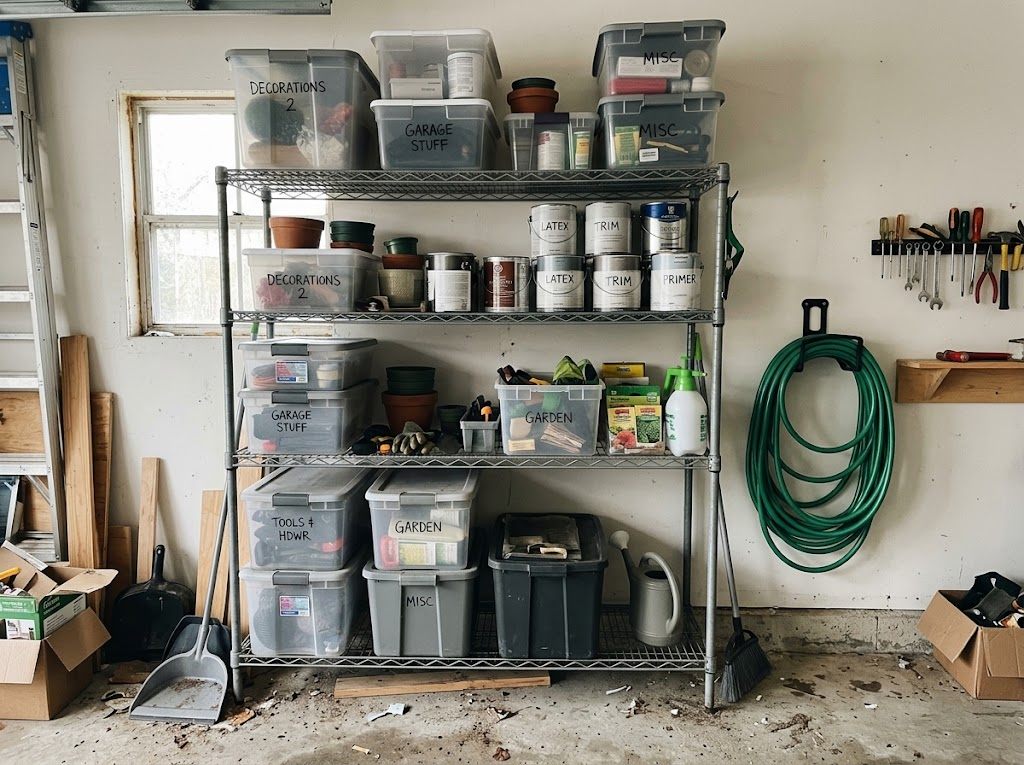
Long Island garages have a few personality traits worth knowing about: in winter the salt comes in on the cars and the boots, in summer the humidity sits at 75% for weeks, and in between, things get knocked over by snow shovels and hose reels with surprising regularity. Shelving you put in a garage is not the same kind of test as shelving you put in a basement. We learned this the way we learn most things — by buying the wrong thing first.
This piece covers three shelving systems we've actually lived with for at least one full year, and one (the wall-mounted setup) that we now wish we'd installed first.
The contestants
1. The $90 freestanding steel rack
5-tier steel-frame unit, 5 ft tall, with particleboard shelves. The version most stores carry; we paid $89.99 plus tax. Assembly was about 30 minutes with a rubber mallet. Stated load capacity: 350 lbs per shelf, which we suspect is generous.
2. The "premium" wire shelving system
Chrome-coated wire shelving, four shelves, with adjustable post heights and casters. About $220 for the unit we tested. The kind of thing sold as a "garage system" but really designed for restaurant pantries.
3. The wall-mounted track-and-bracket setup
Standards-and-brackets system: vertical metal tracks lag-bolted into wall studs, with adjustable brackets and 12-inch-deep shelf boards. About $180 in materials for an 8-foot-wide section. This one required a stud finder, a level, and a drill — not a casual purchase.
How we tested
Each unit lived in our garage for at least one full year. We loaded each one with a typical mix:
- Two 5-gallon paint buckets
- A box of car-care supplies
- Several plastic totes (sports gear, camping, holiday)
- Power-tool cases (drill, sander, an impact driver)
- Roughly 40 lbs of canned goods on the top shelf, because we have a small overflow pantry situation
We checked each unit at the end of every season for: surface rust, frame deflection (sag), shelf cracking, wobble, and ease of getting things on and off it.
How they did
The freestanding steel rack: the budget pick that mostly held up
After three winters, the steel uprights show the most rust spots — small surface speckling at the welds and at any spot where the powder coat got chipped during assembly. None of it is structural, but it looks rough. The particleboard shelves are the bigger problem: in our second summer, one shelf started to bow under the bucket weight, and a small water leak from a kayak we'd hosed off in the garage swelled the corner of one shelf permanently.
The fix is to swap the particleboard for plywood, which costs about $40 in materials. We did this for the bottom two shelves and the unit is back to feeling solid. With that small upgrade, we'd recommend it. Without it, plan for shelf swelling within a year if your garage is humid.
The "premium" wire shelving: looked great, aged poorly
The chrome wire system started shedding chrome in year two. Not a coating "scuff" — actual flakes. Our theory is that the salt-laden air in winter ate through the chrome plating where it had been scratched during loading. Within 18 months, the bottom shelves had visible orange rust spots that bled onto whatever sat on them. We had to put plastic liners on all the shelves, which defeats most of the visual appeal.
The casters are also the wrong call for a garage. Concrete with grit on it grinds the caster bearings; two of the four wheels are now stiff. The unit moves but reluctantly.
We don't recommend chrome wire shelving for a garage in a salt or humidity climate. It's fine in a basement or pantry. In a garage it's living on borrowed time.
The wall-mounted track-and-bracket setup: the surprise winner
This one cost the most up front in time, not money. Installation takes a stud finder and a willingness to drill into your wall. The result is shelving that:
- Has zero floor footprint, so the floor stays usable
- Doesn't move, ever — the brackets don't wobble even fully loaded
- Can be height-adjusted as your storage needs change
- Stays clean because nothing collects on the floor under it
The shelves are 12-inch-deep pine boards we sealed with a satin polyurethane (three coats). Three years in, no warping, no rust on the brackets, no swelling. The only sign of age is some minor scuffing where we slide totes back and forth.
What we'd actually do
If you're outfitting a garage from scratch, our recommended order:
- One wall of track-and-bracket shelving (8 feet wide, three shelves) for the things you reach for often.
- One steel rack with plywood shelves for bulk overflow you don't need to access daily.
- Some pegboard or slatwall for hand tools — a future post.
- No wire chrome shelving.
Total cost roughly $300, plus an afternoon of installation. After three winters of testing, this is the configuration we'd hand someone moving into their first house.
A few small things that mattered more than expected
- Bin labeling. The single biggest jump in usability of our garage came when we put painter's tape labels on every plastic tote. Worth more than any shelf.
- Shelf depth. Twelve inches is the right depth for most garages. Sixteen inches and you'll start losing things at the back.
- Headroom on the top shelf. We learned to leave 12 inches of empty space above the top shelf so we could stack a few things temporarily without unloading.
- Anchoring tall units. Even a freestanding rack should get a strap or bracket to a wall stud, especially if you're in a household with kids who climb.
Final read
Garage shelving is one of those categories where the cheap option, the expensive option, and the right option are not on the same axis. The expensive chrome system was the worst performer; the budget steel rack was fine with one $40 upgrade; the wall-mount setup we initially dismissed as "more work than I want" turned out to be the right answer. We're slowly converting more of the garage to it.