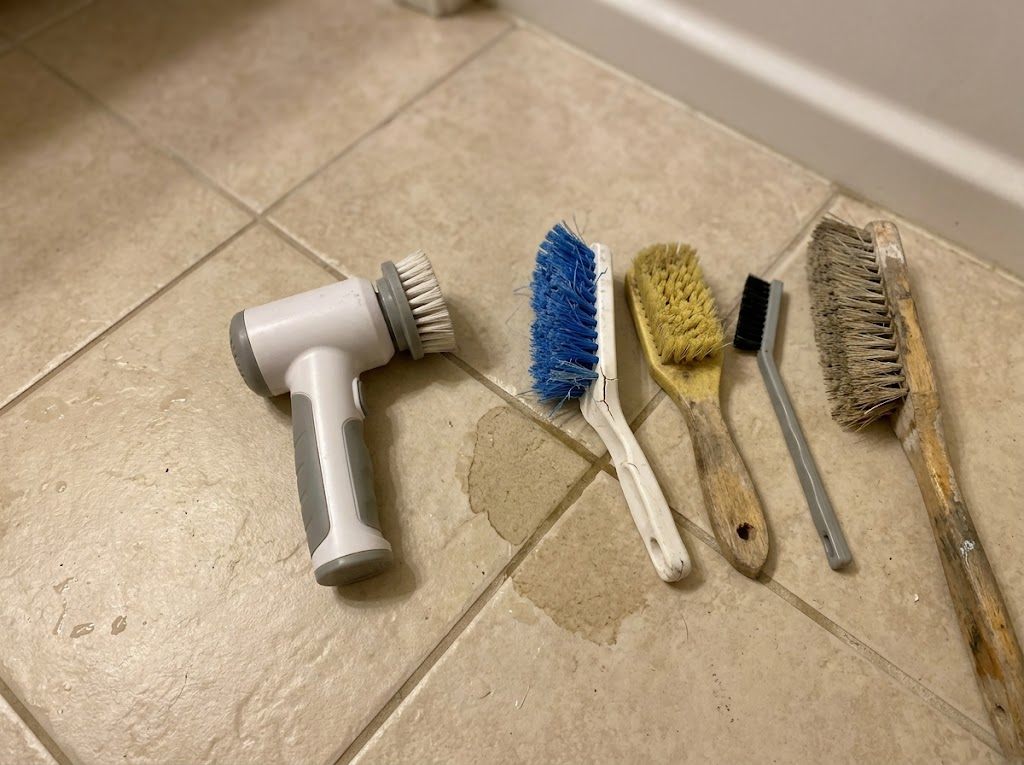
For most of last year, the under-sink cleaning caddy in our kitchen contained four separate scrub brushes: a stiff one for grout, a soft one for stainless steel, a long-handled one for the bathtub, and a tiny detail one for around faucets. Today there is one $20 handheld electric scrubber and a small bag of replacement heads. We did not expect this to happen, and we did not particularly want it to. But after eight weeks of testing, we kept it.
This is a review of a small, handheld, battery-powered scrub brush — the kind of thing that shows up in shopping-feed ads with absurd before-and-after photos. We bought ours at retail for $19.99, ran it through deliberately tedious cleaning tasks, and tracked which brushes it actually replaced. Here's what happened.
What it is, and what it isn't
The category is "cordless rotary scrubber." The form factor is roughly that of a fat electric toothbrush — a battery handle with a chuck on the end that takes interchangeable round brush heads. Most models come with three or four heads of different sizes and stiffness. They spin at a few hundred RPM (not impressive on paper, but enough that you don't have to push hard) and run for about an hour on a charge.
It is not a power scrubber in the sense of a corded tool that takes a 6-inch wheel. Those exist; they're heavier and louder; we'll cover them another time. This is the small, kitchen-counter version.
Our test setup
We ran it daily across a Long Island family home for eight weeks. Specific tasks we put it through, with notes:
Bathroom grout
This is the test the marketing photos always promise. With a baking-soda paste and the medium-stiffness head, the gadget cleaned a one-square-foot section of yellowed grout in about four minutes. With a hand brush and the same paste, the same section took us closer to twelve minutes and made our forearm tired. The grout came out roughly the same shade either way; the difference was time and effort.
Soap-scum on glass shower doors
The soft head with a glass-safe cleaner removed the milky film without scratching. Four minutes per door. We were skeptical because rotary tools can leave swirl marks; this one did not, but you do have to keep it moving — pausing in one spot for too long left a faint dull patch we had to buff out.
Stainless steel sink
We ran it for two weeks as our daily sink-cleaning tool. The soft head and a drop of dish soap kept the sink shinier than our usual sponge routine. One caveat: if you press too hard, the foam buffer at the back of the head can leave streaks. Light pressure is the move.
The inside of a coffee carafe
This was an unplanned test. The smallest head fits down the neck of our glass carafe and reaches the brown ring of coffee oils that no sponge can. About thirty seconds. We were honestly a little annoyed that something this trivial worked this well.
Bathtub
We attached the scrubber to its included extension wand for the bathtub. The extension is the weakest link of the whole product — it flexes more than we'd like, and one of our four cleanings made a faintly creaky sound that we did not love. But it works, and it means cleaning a tub without kneeling. The kneeling pad we love (previously reviewed) is still backup.
What didn't work as well
It's not magic. Two areas where it underperformed:
- Sticky stovetop residue. Burnt-on cooking oil resisted the rotary heads. A traditional scraper plus a Magic-Eraser-style sponge still won here. The scrubber polished it after the scraping, but it didn't remove it on its own.
- Tight corners. The round brush leaves a tiny "moat" of unscrubbed material in 90-degree corners. We still keep a $2 toothbrush-shaped detail brush for that.
So strictly speaking we didn't replace four brushes with one — we replaced four with two. But we did get rid of the long-handle bathtub brush, the grout brush, the stainless-steel-safe brush, and the regular all-purpose brush.
Battery, charging, durability
The battery in our unit is built-in and charged via a USB-C cable in about three hours. We've recharged it nine times over the eight weeks of testing, which means it's holding a charge longer than the marketing implied. The chuck where the brush heads attach has shown no sign of slop or wobble. Replacement heads are about $2 apiece in a multi-pack, and the medium-stiffness head we use most has noticeably worn down — the bristles flatten at the edges — but still scrubs effectively. We expect to replace it every few months.
Worth $20?
For a household that already cleans regularly, yes, with caveats. The savings aren't financial — four hand brushes don't cost much more than one of these — they're physical: less elbow strain, more uniform results, and a higher chance you'll actually do the cleaning task because it's faster. The flip side is that you're adding a small electronic device to a category that has functioned without electricity for centuries. Whether that's a bug or a feature depends on your tolerance for charging things.
We're keeping ours. We will probably end up with a second handle so the heads stop migrating between bathrooms.