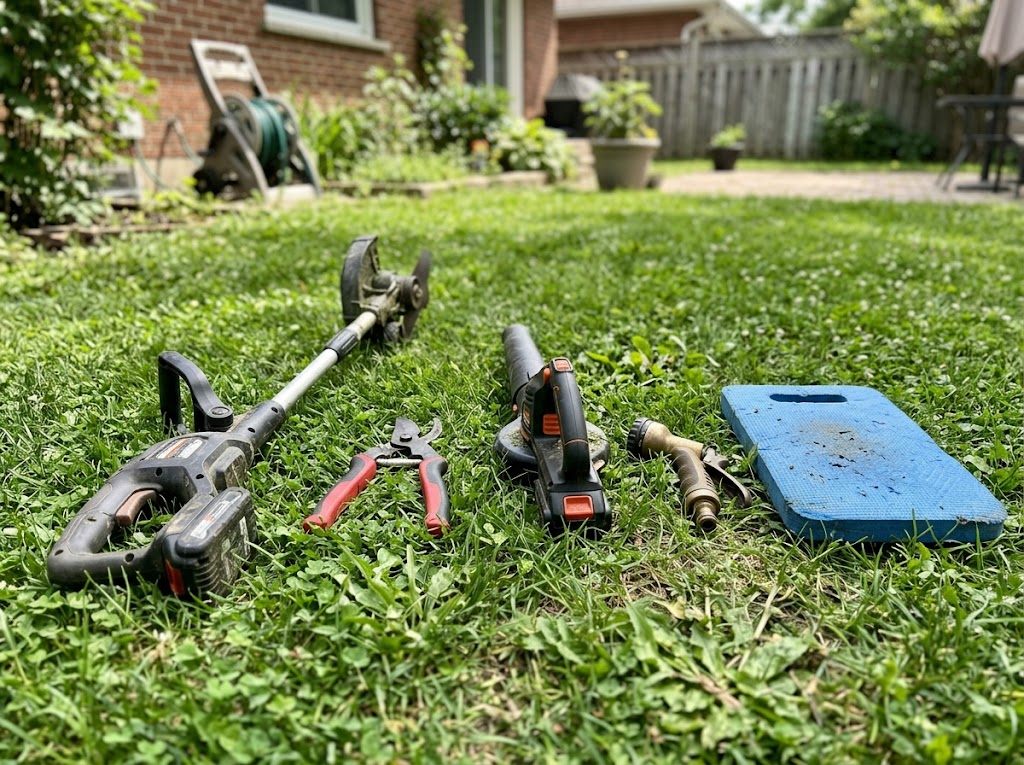
About this time last year we made a small mistake. We decided we'd "build out the outdoor toolkit," which in practice meant ordering twenty-two different items over the course of a few weekends — pruners, weeders, edge trimmers, three different kinds of hose nozzles, two pairs of work gloves, an electric blower we didn't need, and a kneeling pad we are now devoted to. We tested them through one full Long Island year: spring planting, summer mowing, fall leaf cleanup, winter shoveling, and a brief cameo from an ice storm.
Here's the simple result: of the twenty-two, five live in the shed permanently. Everything else either broke, annoyed us, or just sat there gathering dust. This is the list of survivors and what made each of them worth keeping.
How we chose what to test
Our criteria were boring on purpose. We wanted tools that:
- Cost under $80 each (we are skeptical of $300 yard tools as a category)
- Were available at a normal hardware store or online, not specialty-only
- Could plausibly be used by anyone in our household, not just the most experienced gardener
We bought everything ourselves. Nothing was sent for review. That's relevant later, because two of the surprise winners were the cheapest items in the box.
1. A pair of bypass pruners we sharpen instead of replace
We expected this category to be a wash. Pruners are pruners. We were wrong. Of three pairs we tested, the survivor is a mid-priced bypass model with replaceable blades. After roughly six months of weekly use it dulled enough to crush stems instead of cutting them — but a $6 sharpening tool brought it back to factory-sharp in about four minutes.
What you actually want from a pruner
- Bypass blades, not anvil. Anvil blades smash the stem; bypass blades shear it like scissors. Bypass cuts heal faster on the plant.
- A sap groove. The little channel down one side of the blade that lets the blade slide back out of a sticky cut. The pruners without one stuck constantly.
- A real spring. The cheaper pair we tested had a coil spring that popped out twice in one afternoon.
2. A folding pruning saw
The most surprising survivor in the box. We bought a $25 folding pruning saw mostly out of curiosity, and ended up using it more than the cordless reciprocating saw it was supposed to lose to. For anything thinner than your wrist — overgrown rhododendron, a downed maple branch, the rose-of-sharon trying to colonize the fence — the folding saw is faster than getting the battery tool out, finding the right blade, and worrying about extension cords or cuts you can't easily steer.
The blade is replaceable, which matters: ours dulled noticeably by month nine, and a new blade was about $9. That's the price-per-year math we like.
3. A hose nozzle that doesn't leak
We ordered three nozzles. Two of them leaked at the trigger after about a month — a slow drip that turned into a soaked sleeve every time you used them. The survivor is a metal-bodied nozzle (not the plastic kind that splits when you drop it on the patio) with a rubberized grip. It cost about $18 at the local hardware store. Ten months in, it still has zero drip.
4. A kneeling pad we now own three of
This is the cheapest item on the list — about $9 — and it has changed more about our gardening behavior than any tool. The simple foam pad with two handles was bought as an afterthought. By month two we had bought a second one to leave permanently in the front-bed area so we'd stop avoiding weeding. By month six we had a third, which lives in the garage for kneeling next to the car.
The cheap version with EVA foam is fine. The fancier "memory foam" version we also tested compressed flat after two months and never came back. Save the money.
5. A 16-inch leaf rake (the boring one)
We tested a corded electric blower, a cordless blower, and a plain wide-tined leaf rake. The blowers are useful for hardscape; we still use one of them. But for actual leaf removal in a small yard, the rake won on every metric we cared about: speed for small areas, no battery anxiety, no neighbors annoyed at 8 AM, no maintenance. The specific rake we kept is a 16-inch metal-tined model with a wooden handle, the kind your grandparents probably owned. Total cost: $22. Total maintenance after a year: zero.
What didn't make the cut
For honesty's sake, the items that washed out:
- An electric weed puller. Corded, awkward, slower than a hori-hori knife.
- A hose-cart caddy. Wheels broke on flagstone within three uses.
- A "smart" soil meter. Battery died, app required login, didn't tell us anything we couldn't tell by sticking a finger in the dirt.
- Heated work gloves. Useful concept, terrible execution; the heating element shorted in week three.
- A telescoping rake. The locking mechanism slipped under load. We have stronger feelings than the situation warrants.
The pattern we noticed
The tools that survived had three things in common: they were simple, they had replaceable wear parts, and they didn't try to be more than one thing. Every multi-function gadget in our box failed at one of its functions and dragged the others down with it. The boring stuff — a sharp blade, a heavy rake, a sturdy nozzle, a piece of foam to kneel on — kept earning its place.
If we were starting over today and could only buy five outdoor items, it would be these five. Total cost: about $90, plus the saw blades we'll replace once a year.