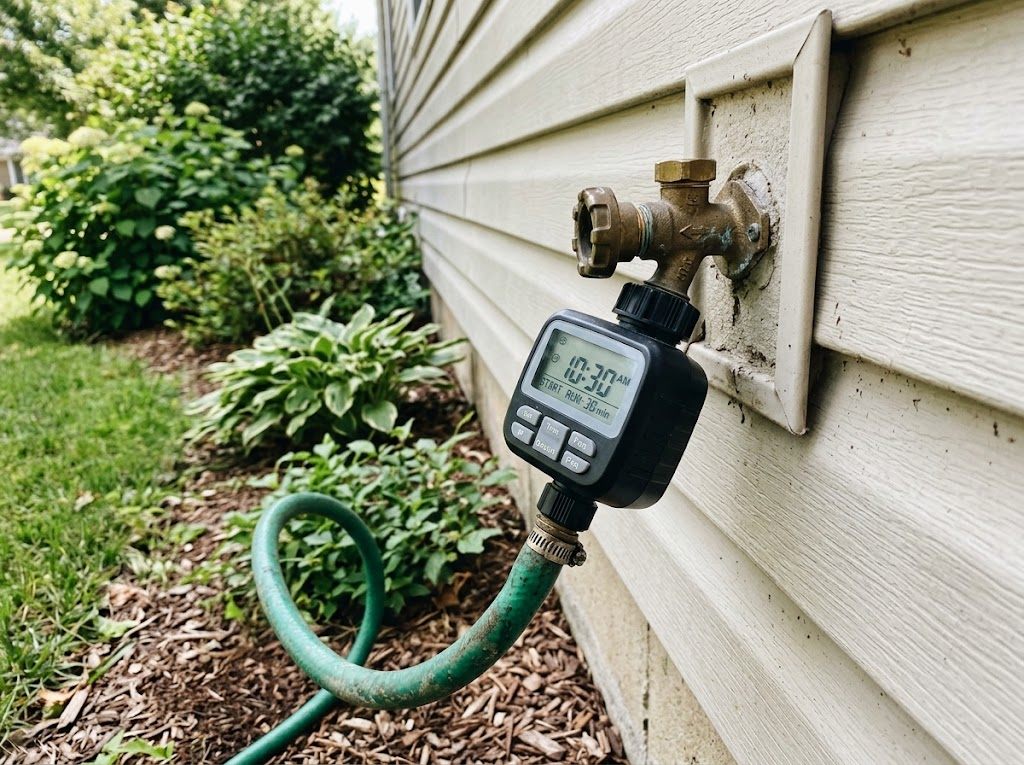
Last spring our raised beds were on a familiar trajectory. They started strong in May, looked fantastic in June, started getting "uneven" by mid-July, and by August we were standing over them with a hose every other evening, telling ourselves we'd be more disciplined next year. We were not. Then in early summer, almost as a side experiment, we screwed a $40 hose-bib timer onto the spigot. We did not expect what happened next.
This is a review of an inexpensive single-zone watering timer used with a basic drip line. It's the gear that changed our garden the most this past year, and the thing we'd recommend most often to people who keep saying they "should really get into gardening."
What we bought
- One single-zone hose-bib timer — about $40. Battery-powered, mechanical-with-LCD interface (not Wi-Fi).
- A 50-foot drip line with built-in emitters every 6 inches — about $25.
- A pressure regulator rated for 25 PSI, because home water pressure is too high for drip — about $10.
- A backflow preventer — required by code in many places, and just a good idea — about $8.
Total: $83 plus a few miscellaneous fittings. The timer is the centerpiece of the whole setup, but the drip line is what makes the timer worth having.
Why a timer changes everything
You'd think the value of a watering timer is convenience: it waters when you're not home. That's a real benefit. The bigger benefit is something subtler and more important.
It moves you off "evening drag the hose around"
The honest reason gardens get under-watered isn't laziness. It's that hand-watering a 6-by-10-foot raised bed thoroughly takes about 12 minutes. Twelve minutes after dinner, after a Tuesday, with the dog needing out and someone needing help with homework, is the longest 12 minutes of the day. So you stand there with the hose for four minutes, the surface gets wet, and you call it. Three days of that and the deeper roots dry out.
A timer running drip line for 30 minutes at 6 AM puts more water in the right places than a bored gardener with a hose ever does. You're not fighting habit; you're replacing it.
It changes how the plants grow
Within about three weeks of switching to drip-on-a-timer, we noticed the plants getting bigger. Not "lush garden magazine" bigger — measurably bigger. Our two cucumber plants put on roughly eight inches in a week we didn't even pay attention to them. The basil bush, which had been sulking in June, doubled in size by mid-July.
The mechanism, as far as we can tell: deep, consistent watering at root level encourages roots to grow downward instead of crowding the surface chasing moisture. Surface watering does the opposite, which is why hand-watered beds can look fine but underperform.
What the timer actually does
Our model has a single dial and a small LCD. We set it to start at 6:15 AM, run for 30 minutes, every other day. That's it. Once we set it, we forgot about it for ten weeks.
It survived a thunderstorm, a ninety-degree heat wave, the dog stepping on it twice, and an unfortunate weed-trimmer incident that gouged the case. The battery (a single 9V) lasted the full season. We replaced it preemptively in March anyway.
The interface trade-off
You can buy "smart" Wi-Fi-connected timers in this category for about $90. We did not. After a season, we still don't want one. The non-smart timer requires zero account, zero phone app, zero firmware updates, and works in a power outage. There is exactly one moment per year — when daylight savings shifts and you'd like the timer to know — when we'd want a smart one. That moment is about three minutes long and we just push the dial.
What surprised us
Less mildew
Hand-watering wets the leaves. Drip-line watering wets the roots and leaves the leaves alone. By August, our zucchini — which usually has powdery mildew written all over it by now — was clean. Anecdotal, but consistent across two beds.
Less weeding
Surface watering grows weeds wherever the water lands. Drip lines water in narrow bands; the rest of the bed surface stays drier; weeds have a harder time. Our weeding workload roughly halved compared to the previous year. We'll take it.
The water bill
We expected the water bill to spike. It didn't. The timer waters less total volume than our hand-watering did, just better-targeted. Our July bill was $6 lower than the previous July. Tiny sample size, but counter to expectations.
What didn't work the first try
- Skipping the pressure regulator. First version of our setup blew an emitter off the line within an hour. Home water pressure is typically 50–70 PSI; drip lines want 20–25.
- Running the line uphill. Drip lines work great horizontally and downhill. Uphill, the emitters at the high end starve. Re-routed.
- Trying to drip-water tomato containers from the same line. Containers want way more water per cycle than in-ground beds. We split them onto a separate manifold that runs a different schedule.
Winterizing
End of season we drained the line, removed the timer, and stored both indoors. The pressure regulator and backflow preventer also come inside. A timer left on a hose bib through a Long Island winter will crack — the internal valve seats freeze and split. Ten minutes of fall cleanup buys you another full season next year.
Worth $40?
Easily. We spent $83 on the whole setup and got back a season's worth of consistent watering, healthier plants, fewer weeds, and a roughly equal water bill. The single most underrated piece of gardening gear we've used.
If you have a small garden, a busy life, and any tendency toward "I'll water it in a minute" guilt, this is the gear that fixes it. Set it up in 30 minutes and stop thinking about watering for the rest of the season.