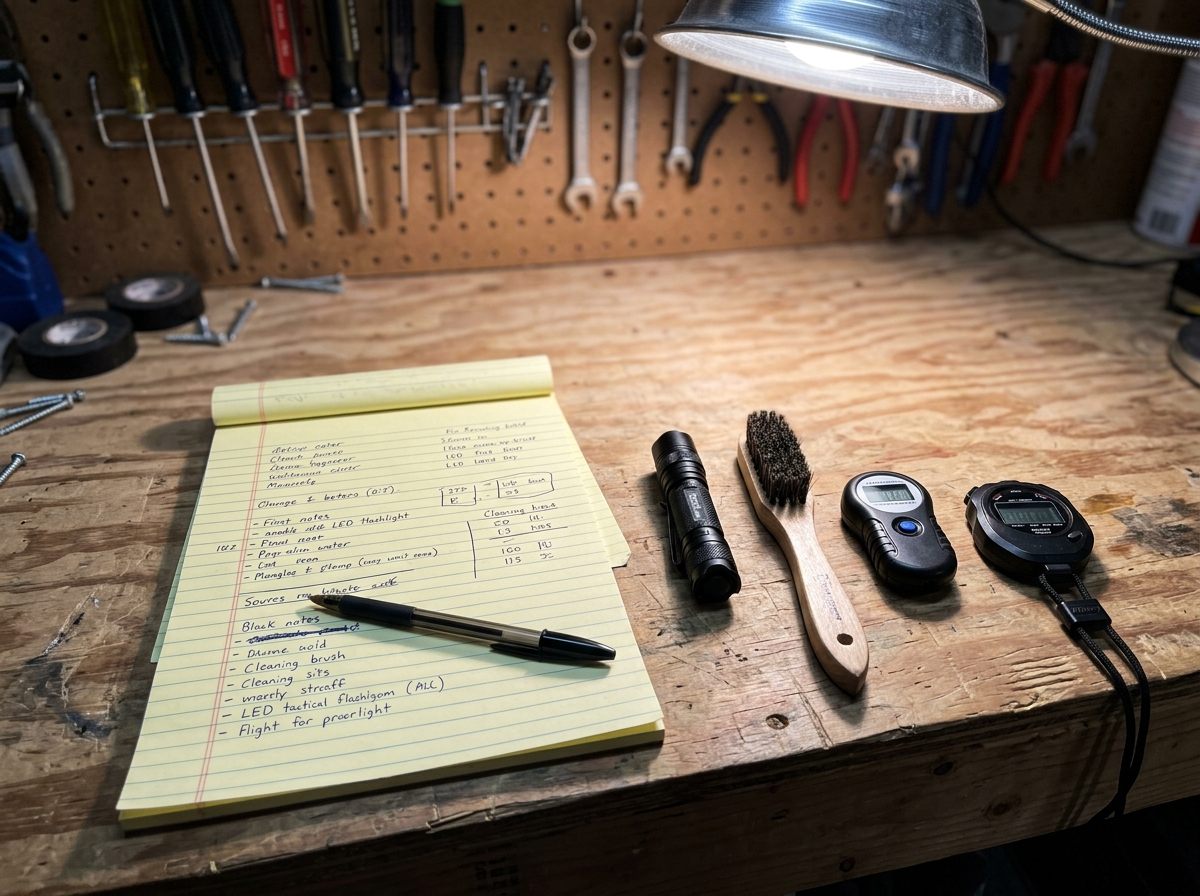
Every review on Handyfinds follows the same general process. It's not glamorous and it's not complicated, but it's how we keep the work honest. This piece walks through it in detail, partly because readers ask, and partly because writing it down is a useful discipline for us. If anything below sounds wrong or fishy, we'd want to know.
The big-picture rule
Before any individual protocol, the rule that governs everything else: we don't write about products we haven't actually used. No "based on customer reviews" listicles. No "best of" articles assembled from manufacturer pages. If a product appears on this site with our recommendation, someone on our team has held it, used it, and formed an opinion based on that use.
This is the constraint that determines our publishing pace. We could put out three articles a week if we cribbed them from spec sheets. We don't, because that's not what we'd want to read.
Step 1 — Choosing what to test
The categories we cover are intentionally narrow: outdoor and yard, cleaning, garage and storage, and garden gear. Within those categories, we choose products by combining four signals:
- What we ourselves need. The most reliable filter. If we wouldn't buy it for our own home, we have no business recommending it for yours.
- What readers ask about. Direct emails, comments left on the contact form, search-trend data we look at occasionally.
- What's genuinely interesting to compare. Categories where the differences between products actually matter to a buyer, not where they're commodity.
- What we can test fairly. If we can't replicate the use case in our own homes, we don't write about it.
We deliberately avoid categories where someone else does it much better than we could. We're not the right place to read about phones, headphones, kitchen knives, or running shoes.
Step 2 — Acquiring the product
The default: we buy it
Roughly 95% of products we test we bought ourselves at retail. We use the same channels readers do (a major online retailer or our local hardware store). This means we see the same packaging, instructions, and quality control any reader would see — and we eat the cost when something is bad.
The exceptions
- Borrowed. Sometimes a friend, neighbor, or local shop has a unit we can borrow for a week. We disclose this in the review when relevant.
- Manufacturer-provided. Rare. When we accept a unit for review, we tell the manufacturer up front: we may not write about it; if we do, we'll disclose that they provided the unit; we may write a negative review; we will not let them see the draft.
Step 3 — The testing itself
Initial assessment
Before we use the product, we record:
- Unboxing notes — packaging quality, manuals, missing parts, instructions clarity
- Out-of-the-box build quality — fit, finish, materials, weight
- Setup or assembly time, with a stopwatch
- What's included vs. what's sold separately
Repeated tasks
For products where direct comparisons make sense (pressure washers cleaning identical sections of patio, scrubbers tackling identical bathtub grime), we run the same task multiple times across multiple products and time it. We're not running double-blind lab studies — there are real testing labs that do this professionally and we'd just be cosplaying. But timed, repeated, real-world tasks are valid evidence and we use them.
Long-term use
Most of our reviews include at least four weeks of "just live with it" time. We've found this catches the things short tests miss:
- Battery degradation that only shows up after weeks of charge cycles
- Plastic stress fatigue (latches, triggers, hinges)
- The quiet annoyances that make you stop using a tool even though it "technically works"
- Whether you actually reach for the thing or it sits in a drawer
Conditions and notes
We log conditions for outdoor and weather-sensitive testing: temperature, humidity, surface, what we were trying to clean. The notebook is messy. Photos get taken at every meaningful step.
Step 4 — Scoring
We don't use a 1–10 score, on purpose. Numerical scores compress nuance into a single digit and create an illusion of precision that isn't there. Instead, every review is graded against a five-axis rubric, qualitatively:
1. Build quality
Materials, fit, finish, durability indicators. Does it feel like it'll survive normal use, or do we expect to be replacing it within a year?
2. Performance
Does it actually do the task it's sold to do? How well, compared to alternatives?
3. Ease of use
Is the user experience pleasant, or do you have to fight it? Setup, daily use, cleanup, storage.
4. Value
Performance per dollar. We treat this as separate from price; a $20 thing that does $80 of work scores well, a $400 thing that does $200 of work doesn't, regardless of absolute price.
5. Honesty of marketing
Does the product live up to the claims on the box? Does it overpromise? This is the axis that most often makes us recommend cheaper items over premium ones.
Step 5 — Writing
Drafts are written by whichever team member did the testing. The first draft is a brain-dump — every observation, every annoyance, every surprise — and is intentionally unstructured. The second pass organizes it into the article. At least one person who didn't write it reads the final draft before publication.
What we won't do
- We won't soften a negative review to keep an affiliate program happy.
- We won't pad a review with filler when we don't have much to say. Some of our pieces are short on purpose.
- We won't recommend something we wouldn't buy ourselves.
- We won't fabricate test data, even directionally. If we didn't measure something, we say "we didn't measure this."
Step 6 — Affiliate links go in last
This is the editorial-firewall step that matters most. We write the review, we lock the recommendation, and then we add affiliate links — never before. The recommendation is never altered to favor a higher-paying program. If two products are roughly tied on merit, we say so and link to both. If the best product in a category isn't part of any affiliate program, we still cover it and link to it.
Step 7 — Updates and corrections
Corrections
Every factual error gets a correction note at the bottom of the article describing what changed and when. Typos and broken links get fixed silently.
Updates
Some categories warrant scheduled revisits. Pressure washers, batteries, anything outdoor — we go back to those reviews after a year and add notes on what aged well and what didn't. Updates appear as dated notes, not as silent rewrites.
Step 8 — Things we deliberately don't measure
For honesty's sake:
- We don't run our own decibel readings — our equipment isn't accurate enough.
- We don't claim "X PSI measured" unless we have access to a calibrated gauge for that test.
- We don't compare warranties as a deciding factor; warranty terms change and "lifetime" means different things at different brands.
- We don't review based on Amazon star ratings; those are too easily gamed.
Why we do it this way
Most of these rules exist because we've all read product reviews online that turned out to be useless — vague, recycled, or quietly compromised — and we'd like to make a publication that isn't that. The methodology described here is what stands between a review you can actually use and a review that just exists.
If you ever spot us breaking one of these rules in print, please write in. Email is hello@handyfinds.co. We mean it.
For more on our editorial structure, see Editorial Standards and our Affiliate Disclosure.